This has been on various UKIP election leaflets, so it’s evidently a claim they’re proud of – but does it stand up?
Simple maths tells us that Britain paying £40 million a day to the EU would mean an annual contribution of £14.6 billion. However, the most recent Treasury Report on the UK’s EU budget contributions (PDF) shows the following GROSS figures:
2005 – £12.5 billion
2006 – £12.4 billion
2007 – £12.5 billion
2008 – £13.7 billion (estimated)
£13.7 billion divided by 365 = £37.5 million, so UKIP are, at the very least, rounding up by £2.5 million a day. Not much to round up by? That works out as £912,500,000 a year – I hope UKIP won’t be that out with their sums if they ever get near power…
But what about the rebate? What about the EU funds that are paid back to the UK in the form of things like the European Regional Development Fund, European Social Fund and the like? What’s the NET contribution? (Again from the most recent Treasury report)
2005 – £3.6 billion
2006 – £3.9 billion
2007 – £4.6 billion
2008 – £3.6 billion (estimate)
UKIP deliberately using gross rather than net to make the situation seem worse is to be expected, of course, but still – let’s be generous and take the highest figure of £4.6 billion – that’s still a lot of money, right? It may only work out as £12.6 million a day, but that’s still a lot of money.
Well, yes. But big figures are nothing without context, so let’s see how much the UK government spends on other things:![]()
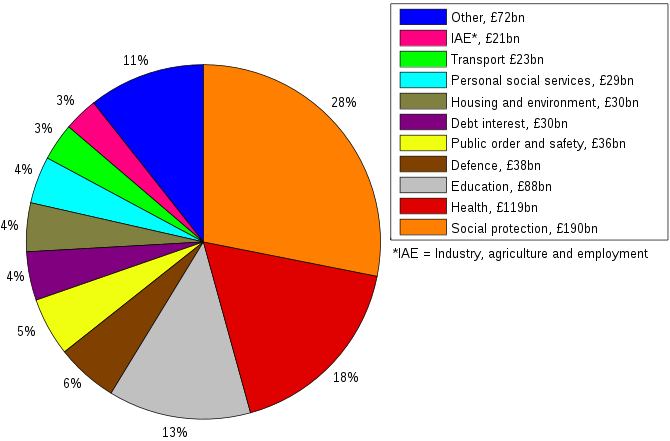
Would you look at that? The UK may be forking out a net figure of around £4 billion a year for EU membership, but at the same time we’re having to pay £31 billion a year merely to service the INTEREST on our debt. That’s not *pay off* our debt – just keep up with the interest. Christ!
In other words, the EU costs us 7.75 times LESS than it does to keep the international bailiffs from the door. (And that £31 billion was BEFORE the most recent round of government borrowing, and before the collapse of sterling, both of which will have hugely escalated the figure for this year, as and when it’s released.)
So, £31 billion in interest payments, for which we see no return whatsoever, versus £4 billion in payments to the EU, from which even its harshest critics must admit that we get *some* benefits – even if they will only admit to cheaper mobile phone charges or ease of travel. I don’t know about you, but I’d say that’s not too bad a deal, in comparison.


May 23rd, 2009 at 6:30 pm
It`s still a very bad deal.
Just because the government wastes or loses money one way doesn`t mean we should throw away even more to the EU .That money given to the project could be used to pay off that debt.
As for the true figure, it`s usually quoted as £16 billion in, but we`ll accept your lower figure; still a waste. But you say we get some back. Maybe, but again you`re forgetting the other costs of the EU – loss of jobs and trade. So in reality the net costs are around the usual quoted gross costs.
So UKIP`s figures are near enough correct.
May 23rd, 2009 at 8:05 pm
I’m getting my figures from the Treasury, from the linked report (that provides detailed breakdowns). That’s as official as they come. Where have you got your £16 billion figure from? Any sources? And where are your sources for the loss of jobs and trade?
It’s very easy to assert things like “£40 million a day”, “£16 billion in”, or “loss of jobs and trade” – and most people will simply shrug and assume that these assertions are more or less right. Personally, I’m interested in getting to the truth of the situation – so any chance of some evidence so that we can all judge for ourselves whether the Treasury’s figures (not mine, please note) are wrong? I’ve been careful to provide my sources for this post, as it’s a highly contested issue, this whole cost of the EU thing (and one that it’s near impossible to get a definitive answer on, thanks to the very nature of the thing) – any chance of you doing the same?
This isn’t me being confrontational – I’m genuinely fascinated to learn where these claims originate, as there is so much distortion from both sides when it comes to assessment of the plusses and minuses of EU membership. (I’d also be interested to see, if you happen to know, where the “80% of laws originate from the EU” claim comes from, as it’s been strongly refuted by both the House of Commons Library and the British Chambers of Commerce – though that’s probably a post for another time.)
May 24th, 2009 at 9:42 am
Did you actually look at the breakdown of our expenditure and see how many of theose little dairylea triangles are directly affected by European inflicted legislation, or if not now, soon will be.
Certaily UKIP will round up to suit their agenda, as do the Government usually round down to suit theirs. It’s called politics, and it’s submerged in lies. Shall we talk about the lies Heath ‘didn’t tell us,’ which are the unmarried mother and father which spawned this debate in the first place, the Bastard EU.
May 24th, 2009 at 10:05 am
William – sure, I’d be fascinated to see how much of British government spending is due to EU regulations. Is there any way of working this out, that you’re aware of? Because there are all kinds of different estimates of how much legislation originates from the EU, from the anti-EU crowd’s (entirely unsourced, from what I can tell) 80% claim through to the House of Commons Library’s estimate of just 9% – it could be anything in between.
More importantly, though, is there any way of telling which regulations would never have entered into force without the EU’s existence? Because part of the whole reason for the EU’s existence is to harmonise legislation to ensure we’re all singing from the same hymnsheet – this means that much EU legislation would have been passed in some form by national governments even if the EU didn’t exist.
May 24th, 2009 at 10:31 am
May 24th, 2009 at 6:41 pm
Nosemonkey,
Your post 23/5@ 8.05pm.
It`s always hard to gey figures about costs ,legislation and impact of the EU because it seems deliberately boring and complicated. How much better it would be, for example, if the EU sent the bill for our membership directly to each household, but then they wouldn`t want to show us the true cost that way, would they ?
I said I accepted your figure from your pie chart. I just mentioned another figure was often quoted .
The trouble is, our government, of whayever political colour, has become like the old Soviet government – distrusted. (The Soviet citizens actually thought the statistics for air crashes were far worse than they were because they didn`t trust their government not to lie ).
I can tell you about the jobs and businesses, but are you interested ? Wouldn`t other peoples lives and work just be an “insane detail “to you, getting in the way of the Big Picture ?
The 80% of legislation is also hard. Basically we dont know when the EU intrudes in, and when it is 100% totally out of it. How and when are we told that the government does enact/not enact some legislation in order to meet a EU guideline, rule , decree or regulation or to avoid a confrontation with the EU ? The reason we have fewer judgements set against us in the EU court is because our government doesn,t want to be seen fighting and losing cases there, so it brings in legislation in anticipation of an EU law to be passed.
The same goes for our civil service, who love to be tied up in EU regulations as it seems to bolster their power .
May 24th, 2009 at 6:44 pm
Nice work, it’s really appreciated that you’d put such an effort into this. It’s so important people can question such slogans as UKIP’s ‘40million a day’ and think critically. But it also helps if people like yourselves can critically deconstruct it and let the reader make sense of those facts themselves.
So anyway, I was i was saying – NICE WORK!
May 24th, 2009 at 7:01 pm
William- “Did you actually look at the breakdown of our expenditure and see how many of theose little dairylea triangles are directly affected by European inflicted legislation, or if not now, soon will be.”
People seem to think that legisltion just comes out of the EU. Even if the EU did not exist, nations would still pass legistlation that would have an impact on the way business is run. However, that is part of a wider social contract, workers rights etc. I cant help but think that many anti-EU types have a hard-on for libertatian mimimal legistlation on business…..they think that by getting the UK out of the EU, it would make it easier to get their little pro-business, anti-worker wet dream.
May 24th, 2009 at 8:11 pm
Evil EUropean,
So you think you`re pro worker do you ? Do you agree with the mass displacement of British workers from their jobs ?
May 25th, 2009 at 8:43 am
EvilEuropean, you have this all totally wrong. As Robin has pointed out, we are now having British workers being displaced by migrant workers. The common reason given is that Polish workers are harder working and more reliable. I, as a humble carpenter, find this highly suspect.
I have the utmost respect for the Polish people; they were brave and true fighters in the war against Hitler. I also admired their fight for freedom under the Soviet Union; a fight that one-day will have to be fought all over again when the EU assumes total power. But I’m wandering away from the point.
Contributions to the EU are just a small part of the total expenditure. We have to have quangos and tiers of bureaucracy to explain, interpret and enforce all of the laws and regulations coming out of the EU. In a free trade arrangement the companies concerned could sort this out themselves. If A wants to sell to B he only has to reach B’s requirements; if the country where B operates decides that they don’t like what A is selling then they can just tell A and he can modify his product. Why do we have to have hoards of self-important legal and civic clowns clambering all over us?
There is another point to be made concerning money coming back to us. Regional Development Agencies in Britain are made up of un-elected busybodies. They have control of the money given by the British taxpayer and recycled by the EU. They decide where the money will be spent and not the ordinary British person. Consultation is an exercise in consulting and ignoring. We even have funds devoted to brainwashing our schoolchildren into loving the EU. As if we needed any persuading to love this most cherished of corporatist projects!!
EvilEuropean, you also state:
“I cant help but think that many anti-EU types have a hard-on for libertatian mimimal legistlation on business…..they think that by getting the UK out of the EU, it would make it easier to get their little pro-business, anti-worker wet dream.”
Where have you been for the last few years? The EU is THE “pro-business, anti-worker wet dream” Try looking up Viking, Ruffert, Laval, and “Flexicurity” It is the hugely corporatist agenda of the EU that is producing reams of legislation that so impinges on the “working classes”
The sole intention of any corporate industry is to have an excess of labour. The employer can then enforce lower wages and conditions onto the workforce; if the workforce doesn’t like it they can move on because the employer has a readily available replacement migrant workforce.
I am your average working class man on the street. I can see through all of this nonsense; I just can not see how anybody who claims to be standing up for the workers can go along with this exploitative corporatist construct. You have been totally hoodwinked.
May 26th, 2009 at 9:54 am
I am not too great with figures; but UKIP are not, according to them using gross payments but net!
The net figure for 2007 at £4335 bn being slightly lower than your stated figure of £4.6 bn.
However it could well be argued that the payments should be described in gross, because although a proportion comes back it is not necessarily spent in the way we would wish and is often used to prop up EU projects. It is rather like using that sort of argument on which to base our tax payments, as most of it comes back in one form or another.
The figures are based on the Batten report which uses the term “cost” rather than “pay” and includes both direct and indirect costs, such as CAP, CFP and over regulation. Batten claims that the real costs are very likely much higher than his report indicates and challenges the government to do a real cost benefit analysis, making the point that if there was a real benefit the government would be shouting it from the roof tops.
Batten estimates the EU is costing us £55.775 bn per annum £4.647 bn per month £152.8 mil per day so the UKIP figure of £40 million per day looks conservative.
May 26th, 2009 at 12:52 pm
Hmmm… A report by a UKIP MEP (with no background, that I’m aware of, in accountancy, finance, or anything that would give him the experience or qualifications to audit anything, let alone one of the most complicated and opaque economic/political relationships in the world), published by the anti-EU thinktank The Bruges Group? Hardly an impartial or confidence-inspiring source, there…
Still, the fact that there are so many different figures available for the costs of EU membership just goes to show that a) there needs to be a proper cost/benefit analysis, carried out by independent auditors, if we are ever to be able to form rational and defensible conclusions about the positives/negatives of membership and b) UKIP’s £40 million claim is not clear-cut fact, but an estimate based on unclear workings that tallies neither with official Treasury figures nor with a report put out by one of their own MEPs.
May 26th, 2009 at 1:14 pm
I think the point is that you have used only direct costs to try to discredit the £40 million when the £40 million includes indirect costs! A little bit of spin in favour of the EU I think.
I would not be to down on the UKIP £40 million a day as the Batten report claims £152.8 mil a day, given that you do not trust the report, at least UKIP are only claiming less than a third of that figure.
I would agree that the government needs to do a cost benefit analysis, the fact that they continue to refuse to do so speaks volumes.
May 26th, 2009 at 1:26 pm
Ken – my interest is merely in where UKIP got their figure (and what the real figure is), I’m not remotely interested in spinning in favour of the EU, I merely thought that £40 million a day seemed rather high – and according to official Treasury figures, it is.
But by your own admission, if you accept Batten’s figures for the gross *costs* rather than payments, then the £40 million is £112.8 million short. Why not go for the even larger figure?
The £40 million only seems to make sense as an exaggeration of the gross payments the UK makes to the EU according to the Treasury (c.£37.5 million a day) – not least as their wording is “£40 million daily EU bill” (bill, not costs, therefore implying payments, not alleged compound expense of membership, both in terms of payments *and* negative impact on the economy, business, etc.).
So where *does* the £40 million come from? What is this “bill” they are referring to if not the alleged payments? Have they simply rounded up the Treasury’s £37.5 million a day gross to the nearest £10 million? And if so, considering this is a difference of more than £900 million a year, does this count as dishonest campaigning?
May 26th, 2009 at 7:19 pm
Nosemonkey, a little bit petty but I have just this day came across something that shows how annoying and costly the EU law-making machine can be.
I attended a fire course during which we were asked to use various fire extinguishers on a variety of fires. The British have had a colour code in use for some time now for the different types of fire – water, foam, CO2, and powder. In the environment in which I work it has proved fatal when valuable seconds are lost in fighting or escaping from a fire. Being able to recognise the appropriate extinguisher for the individual type of fire is an absolute must.
All British fire extinguishers must now be phased out to be replaced with extinguishers that are all of a bright red colour with a small, different coloured triangle on each, because of EU law. Instead of being able to recognise instantly the type of extinguisher from the colour of its body I must now go from one to the other, turn each this way and that, and search for the right coloured triangle.
I highlight this as an example of the extra costs incurred on businesses in Britain due to unnecessary law from the EU. It just seems pointless, costly, and in this case dangerous.
May 26th, 2009 at 7:24 pm
But WG, that’s an example of idiots making bad laws. Westminster makes just as many stupid laws. Given Westminster makes 90% of our laws, Westminster makes more bad laws.
The problem with the EU lawmaking process is lack of transparency—ministers agree the laws behind closed doors and the Parliament doesn’t have enough powers to do its job properly.
Blaming whichever institution made it for every stupid law that’s passed is easy, the important thing is to get better scrutiny within the legislative process.
So voting for MEPs that’re likely to turn up would be a good start.
May 26th, 2009 at 7:58 pm
Mat GB,
How come you say 90% of our laws come from Westminster.?
Are you excluding all the SI`s that Westminster makes as it transposes EU law into British law ?
Did you hear the radio about the problems of the motorbike tests this morning ? BBC managed to muff up the interview AND not mention that the problem stems from the EU. Typical of how we are informed by the state broadcaster.
WG
I beleive the EU also banned the use of an inert gas in fire extinguishers because it`s a “pollutant”. Yet what does a fire do to the atmosphere as it burns in chemical factories ?
May 26th, 2009 at 8:34 pm
WG – do you happen to know *which* EU law this is? I’ve not heard of it before, and a quick Google’s turned up nothing especially concrete.
Robin – on the 90% of laws from Westminster thing, I think Mat’s referring to the House of Commons Library report from 2006 that suggested that only 9% of Westminster legislation originated from the EU (sorry – don’t have a link to hand, though I’m planning a post on this shortly, so will give a full reference then). I’m not sure if they included statutory instruments in that – possibly not, as a recent British Chambers of Commerce report (from earlier this month) stated that about 20% of regulation stems from the EU. That probably accounts for the statutory instruments. (The “80% of laws” thing so frequently quoted by eurosceptics, meanwhile, I’ve never seen any original source for – it seems to be something that’s just been repeated so often that it’s taken on a life of its own.)
On the motorcycle thing, I have no idea what you’re referring to – any chance of a link, or something more specific than “on the BBC this morning”? The BBC has several dozen TV and radio stations, after all…
May 26th, 2009 at 9:34 pm
2005 according to when I got the comment:
http://not-little-england.blogspot.com/2005/10/euromyths.html
But the link I was given has either expired or moved, it now appears to be about magistrates courts :-(
Robin, I have never seen a single reputable source that backs up the 75/80/90% of our laws from Europe myth. I have seen it debunked.
The only possible source I can think of for the myth, for that is what it is, is that in the single year 1992, 90% of the new laws that came into action for that year were from Europe. Which is because that was when all of the single market legislation dating from the mid 80s when Thatcher signed up to the Act came in all at once.
If an SI is introduced because of Brussels legislation, then it’s a new law as a result of Brussels legislation. If an SI is introduced and ministers use Brussels as an excuse, then that’s a Minister abusing their position and blaming someone else.
And no, I heard nothing about motorcycle tests. Perhaps tell us what you’re talking about, and link to a source about the “came from the EU”? It may or may not have, it may or may not be good law, bad laws come from my local council on occasions—I want to abolish that for entirely different reasons.
May 27th, 2009 at 8:01 pm
Nosemonkey And Mat GB,
Sorry the motorbike report was on Radio 4 Today prog (The only BBC Chanel I`ll listen to and even then more to monitor their bias than information ).
New EU laws about Motorbike tests. One regulation is that braking tests must be at 50kph.
50 kph is 31 mph, the old speed at which the braking tests were carried out was 30mph. The old tests were done on quiet public roads with a 30 mph limit. Of course the new tests cant be taken on those roads – they have to be taken on roads which have at least a 40 mph limit.This makes a completely differnt safety angle, so new test centres at great expense have been built.The travelling to and from these may put many of the smaller motorbike tuition companies out of business (another “insane detail ?”).
This `might shed some light on the EU/British law 80 or 9 % conumdrum. The EU law might be simple – Brake test at 50kph. The British laws to comply will have to be detailed. Do we attribute the bigger percentage to the EU or to British law ? Surely to be fair it should be put down to EU law, therefore the 80% seems the correct figure.
May 27th, 2009 at 8:33 pm
Robin – I’d blame that on the British civil servants you hate so much for over-complicating something that’s actually very simple. Because the building of special test centres and the like could all be avoided if one tiny alteration was made to the law on speeding to allow motorbikes on tests to go 1 mph above the speed limit on 30 mph roads. (And in any case, I could have sworn we had a 1-2 mph leeway on speed limits, so perhaps even that’s unnecessary?)
May 27th, 2009 at 8:43 pm
Nosemonkey,
The 2mph +10% is an unofficial concession that they revoke in the courts if you contest any speeding offence. And you cant have speed limits then government organisations make private individuals excempt for expediency.
The prmary cause is the EU (we managed before without this interference) and as you say our civil service show again why we are unsuited to this project.
May 29th, 2009 at 9:15 pm
Excellent piece of work nosemonkey, you really have to dig deep to try to make sense of this stuff. I probably represent a large number of British voters when I say that I have been fairly ambivalent towards politics in recent years, mainly because it doesn’t seem to matter who you vote for, it appears to make little difference. At the moment I have no idea who I would vote for.
The recent furore over MP’s expenses however has made me take more interest, on the grounds that if our political representatives can’t be trusted then maybe I should take a closer look at what they’re doing! I’ve therefore been trudging through the web trying to make sense of Europe. UKIP’s claims about Europe certainly get your attention, but are they true!?
It would be a triumph for democracy if the main political parties could actually get together and publish some completely transparent facts (on which they agree!) about these issues, supported by their own party’s opinion on the relative benefits and disadvantages of membership that would give us a flavour of why we should vote for them rather than another.
I was interested to find out from the website of Richard Ashworth MEP (South East) that there are four main sources of income to the EU budget, one of which is our net contribution. The other three are levies on agricultural goods produced under CAP traded with non-EU countries, customs tariffs from goods imported from non-EU countries and a levy taken from VAT paid in each member state. I haven’t found out the value of these other contributions nor an estimate of the impact on our economy, but wonder how/whether these feature in the UKIP headlines?
I have also found this article by Paul Stephenson (Open Europe) that refers to the staggering number of pieces of EU legislation passed – 10,000 in the period 1957-1997 and 22,000 during 1997-2005. This article also refers to the fact that 77% of the cost of regulation on businesses in the UK stems from EU legislation. Perhaps this explains the 75%-90% statistic?
http://www.openeurope.org.uk/research/10stephenson.pdf
May 29th, 2009 at 10:57 pm
Paul – thanks, and some interesting stuff there that I should follow up in more detail when it’s not 11:50 on a Friday night and I’m a bit pissed.
One thing though, on your last paragraph – don’t have the link to hand (but the report should be easy to find on their website, as it only came out this month), but the British Chambers of Commerce recently estimated a figure of 20% for regulation stemming from the EU that affects UK businesses and (if I remember correctly) estimated a *net* cost of around £2 million (yes, with an M, not a B) per year.
Am hoping to do a post on this shortly. I’m not saying I believe the BCC’s figures, but it is yet more indication that *nobody* actually knows how much the EU costs or affects anything or anyone. I’m interested in the reality, not the political spin. I used to be anti-EU, after all. If the evidence is there, I’ll happily switch back – but the evidence the anti-EU side tend to use is usually anything but convincing once you start looking into it (or at least, so I’ve found over the last six years or so…)
May 30th, 2009 at 12:01 pm
Even if the £40 million per day were correct, that, for a population of 60 million, is about 65p per day per person, to maintain good contact with 375 million neighbours in 70-odd countries. By comparison, UKIP MEPs, for their supporters in constituencies of some 80,000, are costing, I gather, £300,0000 EACH, per annum, plus expenses, and what for? To disrupt proceedings, throw paper aeroplanes about, and generally act like badly-behaved schoolboys. Heaven help us if they ever got into power!
May 30th, 2009 at 12:08 pm
Even if UKIP’s £40 million per day figure is correct, that makes, for a UK population of 60 million, about 65p per day per person (even babies can be included, since they do grow up!). By comparison, the UKIP MEPs represent only PART (their followers) of constituencies of some 80,000. At, I gather, some £300,000 plus expenses per MEP per annum. And what for? To disrupt proceedings, throw about paper aeroplanes, and generally act like badly-behaved schoolchildren. Heaven help us if they ever got into power. We’d be prisoners in an isolated country run by lunatics.
May 30th, 2009 at 6:58 pm
Frederick Robinson,
How come the recipient countries dont stump up 65p per day to be in this project ?
Why do we need to pay this to be in “contact” with those others ? Why have you given a figure of 70 other countries.?
Wouldn`t that £40 million be better spent on ourselves ? Are we awash with money in this country that we can throw it away without seeing any benefit from it ?
May 31st, 2009 at 12:43 pm
Robin,
Those that can afford it, DO pay (and some more than us!). I don’t know how old you are; but I was born at the beginning of WWII, which financially crippled the UK (and many other countries) for decades, as well as taking the lives of millions. In the forties and fifties, travel outside the UK entailed tight border and currency restrictions, and regulations that effectively made citizens prisoners in their own countries. ‘Spending the 65p per person per day on ourselves’ – a bar of chocolate? bottle of fizz? a newspaper? – would potentially bring down those prison bars again. Only with the EC/EEC/EU did things loosen up. Inevitably with 375 million people to administer (sorry about the ‘70′ countries; a mistype in the heat of the moment), there are difficulties, complications, opportunities for abuse; but I’d rather that AMENDABLE situation than the irreversibility of war.
May 31st, 2009 at 12:45 pm
65p a day for a family of 5 = £1183. !!
What am I paying such an amount for?! I don t see any benifits to this!
The EU keeps saying Lisbon is a great thing and that everyone wants it, why then are they affraid to let the people vote!?
May 31st, 2009 at 12:56 pm
Ryan – you’re not paying 65p a day for EU membership. Because UKIP’s claim of £40 million a day is a huge exaggeration.
But based on the figures given above, the government IS spending £1.41 a day for every single man, woman and child in this country to pay off the interest on our national debt. For a family of five that’s £2,583 per year.
For interest payments we see no benefits whatsoever; for the EU we see some benefits – even if the extent and worth of those benefits is hotly contested.
Have the people been asked about involvement in the EU? No, not recently. But have the people EVER been asked for permission for the government to run up vast amounts of debt on our behalf, to be paid off with our money at huge rates of interest? No. Never.
May 31st, 2009 at 1:09 pm
Robin,
P.S. My reason for raising these matters is UKIP’s complaint about what amounts to 65p per person per day to achieve something the purpose of which I’ve just tried to illustrate. Perhaps you can explain to me the logic of a United Kingdom Independence Party that accumulates Members of the EUROPEAN Parliament (MEPs) at (as they seem to delight in admitting) INORDINATE expense (inordinate, in my opinion, only because they WASTE it), simply to disrupt proceedings. Serious MEPS (700-odd to represent 375 million, compared with Westminster’s 600 to represent 60 million) are, if we’re talking financial value, 5 or 6 times less-expensive than British MPs, even disregarding the latters’ expenses abuse. UKIP simply add to the bill for no reason while (since they have NO chance within the EU of destroying it) travelling on what they claim to be a gravy-train and creating jobs-for-life for themselves as interminable protestors. They could only WIN if the EU became an enlarged UK, or Britain became Prison UK (with UKIP’s stentorian leader as head-jailer); or, as at present, by wasting time at your and my and the EU’s expense. I respect UKIP’s democratic wish, but I suspect their tactics (honest strategy I cannot perceive).
May 31st, 2009 at 7:08 pm
Frederick Robinson,
65 p per person per day is £4.55 per week per person which is £2366 per person per year.So for the family of five that is £11830 per year.
If the EU is such a good bargain why dont they tell us this figure and why dont they bill us direct ?
So why are some paying for this and some are not (I`m talking here about the tax involved, not the loss of trade or jobs yet)
We know about WW2 and its cost , but that`s another era and you cannot prove that Britain would be involved in another war again but for our membership of this project . We had currency restrictions after the war because of the exceptionable circumstances but we dont have them now with countries inside or outside the EU .Border controls, as we see by the mass out of control immigration are a Good Thing , and dont forget we cannot deport undesirables if they are EU citizens, and those Romanian rapists who came here just to get a cushy life in a UK prison.
As for the performance of UKIP MEPs in Brussels, you damn them if they do and damn them if they dont. How can they work properly in the sham parliament and hasn`t that parliament shown some petty undemocratic antics ?
Dave,
Just because money is wasted one way by the British government doesn`t mean that it should waste more money by shovelling sacks of shekels into the EU.
You claim the EU has disputable benefits and therefore that is a reason for being in. What about the drawbacks (not including our contributions) like loss of jobs and destruction of trades and industries ?
So we could write off our debt nearly five times over just by not wasting money giving it to the EU.
May 31st, 2009 at 9:11 pm
Robin, 65p per day (based on exaggerated UKIP claims, anyway) is, as you correctly compute, £4.55 per week. But multiply this by 52 and the annual total is not £2366 as you suggest, but £236.60. This, I suspect, is the kind of intentional or erroneous exaggeration UKIP indulge in when it suits them. Your family of five total would then be ten times less than your figure of £11830, i.e. £1183. Compare that with your UKIP MEP’s salary: you’ll find he costs twice that amount PER WEEK, excluding travel and expenses. ‘Why don’t they tell us this figure, why not bill us direct?’ Do you ask this question of our (currently deeply-discredited) national Parliament? Who do you mean by ‘us’? The UK is billed direct; perhaps not you personally. And like any ongoing transactions, sometimes A is in credit, B in debt, sometimes vice versa. Negotiation is all. The alternative is put up the barriers and prepare for war. I ‘cannot prove (I don’t want to!!!) that Britain would be involved in another war again’; but have you forgotten Yugoslavia, the Falklands, Iraq, Afghanistan, Somalia, Nigeria, etc., etc?
May 31st, 2009 at 9:16 pm
Robin, if you stick to making serious points that demonstrate a basic understanding of how the British system works, you might manage to make some coherent points, but to answer your questions:
They do, the figures stated above are in the public record and publicly released every year. That the media/you tend to do little to no analysis of the figures is not a fault of the people that publish them
Because we have a system or progressive taxation in this country in which our incomes are taxed according to our ability to pay, and the items we buy are taxed according to their value? In addition, we are not billed for membership becasue each country is a Member State, and has a membership bill as a result, that bill is paid for out of general taxation, the figures for which are, I state again, published annually
Because not everyone earns income, not everyone purchases items that attract VAT, etc.
This is politics/civics 101, surely?
Because when you look at the state of our economy when we joined (the phrase “sick man of Europe” mean anything to you?) to where we are now, we’re all, substantaially, better off.
Economies change, a dynamic economy is based on the idea that old jobsa re phased out and new ones created. Barring the recent economic difficulties caused, primarily, by actions taken outside the EU, our economy was in the best state it had ever been.
Seriously, there are some legitimate arguments you could be making. Destruction of the economy is not one. You might want to blame that purely and squarely on the actions of successive UK Govts, from Thatcher onwards.
June 1st, 2009 at 6:50 pm
Frederick Robinson,
My aplologies it is £236 which makes it 1183 for the family of five.
Which, although 10 times less than my erroneos figure, is still a waste of our money to be in a project that does not do us any good. the figure of £40 million a day could be spent properly here on ourselves as we do not have money to waste.
As regards the premise that but for our membership of this project we would be at war I think this is another scare tactic without foundation. The wars you mentioned have happened while we have been in the EU, and our EU “partners haven`t helped us here.(and some are nothing to do with us ).
I wouldn`t have to pay the UKIP MEP`s salary (and LibDims and Labour and Greens) if we were not in the EU. Plus can we stop saying that we can throw away money in one area just because the government has thrown it away in another ?
Mat GB,
I understand how our system works as much as the next man, and sometimes, because of the nature of my business, I am given an insight into its failings.
The figure given is always open to dispute because of the complexity of this. How about then, you tell us how much the EU gave to Britain last year ?
We are not billed directly because of course it is easier to collect this way, but the EU couldn`t collect if it did bill directly because then we would know the true cost. It doesn`t stop the EU from putting its Ring of Stars on every project that it is involved with, thus helping to foster the “beneficial” side and hiding the cost.
And as you say not everyone has income, so the true figure for taxpayers is back up to the UKIP figure.
We would be substantially better off anyway, as all countries are outside of Africa. We were the “sick man of Europe” but that was also the period when we joined the Common Market. The reforms of the eighties by Maggie stooped that, not the EU.
Economies do change, but that is no reason for our powers that be to sabotage perfectly good jobs for no good reason except a Reverse Luddism attitude prevalent in Whittehall. Not everyone can have a carreer, some have to make do with jobs. As our foreign competitors seem to know and make use of.
If my way of life (not just my livelyhood, my actual way of life ) was destroyed because I was lazy, incompetent, stupid ,greedy unneccesary, then that is acceptable. But it wasn`t and a good part of the reason is because of the EU.Is it acceptable to destroy a Rainforest Indian`s, An Eskimoes, a Gypsies or French farmers way of life for no good reason ?
Destruction of our economy ? I thought you said it was in good health because of the EU ?
June 2nd, 2009 at 11:02 am
Robin,
Thank you for your apology. The end of your last letter suggests that (right or wrong) you blame the EU for what seem to be unfortunate personal circumstances; and if, as suggested at least, you have a family of five to support, you hjave my sympathy. But I could have said the same about MY circumstances (’downsized’, hence divorced, my children taken, jobless for 2/3 years) in the Thatcherite 80s: along with, let it be said, 3 million others! Mrs T’s reforms (not all of which I criticise: having it suggested I was ‘not unemployed, but a one-man business seeking custom’ I found psychologically very liberating) led, however, to Cardboard City, the death of the mining, shipbuilding and other industries, with concomitant demise of communities and – under-resourced – need for social aid on a large scale; and the glorification of the financial (banking, dealing, etc.) sector beyond reason, to the point where the bubble has burst internationally….As for the recent wars ‘within Europe’, the last time there was a problem in Yugoslavia, Sarajevo 1914, the various networks of non-co-operating national alliances resulted in WW1 and MILLIONS of dead. This recent time, nasty and protracted as it was (and in my opinion the result of capitalist machinations to destroy the last Communist state in Europe apart from Russia; remember Fukuyama’s book ‘The End of History’ erroneously anticipating the final success of capitalism – cf the Credit Crunch) the EU did not rise to the bait. Partly because they are committed not to do so.
June 2nd, 2009 at 2:42 pm
Frederick Robinson,
Although you have my sympathy for your plight in the eighties , the cutbacks that Mrs T made are not the same as the decimation of my industry by the econoomic sabotage of our civil servicewho imply it is at the behest of the EU.
Whether the wholesale loss of jobs and the way it was done ,plus whatever cushioning was given to those affected can be points for dispute, can you tell me any good reason why my industry should be killed off and replaced by foreigners ?
You mention about the demise of the communities that happened due to the eighties policies. At least the workers involved were not replaced by foreign ones and told to move, not just to a different locality in the UK, but to another country, which is what we are told now DUE AGAIN to the EU.
Thatcher and Tebbit may have seemed harsh, but why are the ones who advocate this mass movement of people now not condemmned for their callous attitude to the working man?
Regarding Sarajevo and WW1. Britain had an age of “Glorious Isolation” and tended not to worry about European affairs. Then some within some circles worried that we were losing “influence” and wanted us to go to all the international treaties and meetings.They wanted to “build alliances ” and get involved.So we did and ended up in a world war.
June 2nd, 2009 at 3:39 pm
We did? Did that get completely skipped over in all the books I read on British history before abandoning the idea of becoming a history teacher? When was this pray tell, I’ll go and check some reputable sources and re-educate myself.
They imply? They imply? That’s it? Cite sources, give a law, actually back up your assertions with some facts.
Comparative Advantage, it’s been a basic principle of economics for the last 200 odd years. We have a dynamic economy, we’re best doing what we’re best at and importing stuff we’re not so good at.
The best explanations of this I’ve ever read were by a certain Tim Worstall, who happens to be a UKIP candidate and their press officer.
But you’ve still not actually provided any real evidence other than a dislike of foreigners for your position. So, unless you actually back up your assertions with actual facts, actual legislation and actual real reasons, I’m not going to waste my time on you any more.
I don’t give a shit who does a job, I care that the job is done well. You care that it’s not done by foreigners, but insist you’re not racist? Give me a break.
June 2nd, 2009 at 4:30 pm
Mat GB
Britain`s Glorious Isolation was between 1870 and 1910. I dont know what you`re teaching ?
The economic sabotage can be proved by the correspondence with the department of Transport. You`re welcome to see it as proof, if you can understand such things.
Comparative Advantage ?! have you ever been in business ? Our trucks have to pay when in other countries, they dont pay here. We are strictly regulated, they are not. That`s just the half. does that sound like a fair competition ?
Dislike of foreigners and racist. Read the posts properly before making stupid assertions and uncivil comments. You`re a typical self regarding prig. I`m glad you`re on their side.
June 2nd, 2009 at 4:46 pm
Robin – other than noting that you’ve forgotten the 1904 Entente Cordiale, I suggest you look up the 1860 Anglo-French Treaty of Commerce, which remained in force for most of the next 40 years. From a handy online review of a recent book on the subject:
“As a result of the treaty, a network of bilateral trade agreements based on most favored nation (MFN) trading status spread across Europe as other countries sought to obtain equal access to the French market in the aftermath of the accord… This network of treaties was never formalized into a single regime, but British policy makers did explore whether a pan-European trade agreement would be viable.”
Britain has *always* been closely involved in Europe – if not obviously in the midst of the action, then behind the scenes working the diplomatic channels. And Britain was *especially* active from 1870-1910, as this was the major period of European imperial expansion (especially into Africa) – as well as the principle period in which the rest of the world began to catch up to Britain’s level of industrial and commercial development – and Britain had to protect her interests. Indeed, c.1870-1910 is arguably one of the most intensive peacetime periods of British diplomatic involvement in both Europe and the world that you could name.
June 2nd, 2009 at 5:31 pm
Nosemonkey,
My apologies, the term was called the Splendid Isolationist period although someone like MatGb who purports to be a history teacher cant diplomatically correct the terminology does not inspire confidence for our childrens future.Perhaps he is as ignorant as that.
I wouldn`t claim that is was universally popular but it was the vogue at the time until Edward VII.
We may have had that treaty but dont forget the Fashoda incident of 1890.I`m also aware that Germany was one of our biggest, if not the biggest trading partner .
June 2nd, 2009 at 5:39 pm
Reading comprehension not top of your list of acheivements is it (sorry NM, but this is just beyond daft now). I said:
I’m not, nor have I ever been, a teacher. I considered becoming one and have a lot of background knowledge of history. “splendid isolation” is not a term I’ve heard before, and as NM said, while it may’ve been used in propaganda or by rose tinted backlookers, it’s palpably ahistorical.
And if you’re blaming the idea that UK trucks are regulated while others within the EU are not on the EU, there’s a logic flaw there. I’ve already agreed with you that the daft way we tax vehicles in this country is daft, but that’s not an EU policy either. If treasury correspondence says it is, then whoever wrote the letter was lying, get them for it, don’t blame an organisation that had nowt to do with it.
*unsubs from this thread, it’s not worth it*
June 2nd, 2009 at 6:26 pm
As the Mat GB poster cannot understand others and misreads posts we will have to ignore his factually incorrect last one.
June 3rd, 2009 at 9:42 am
Robin:
I don’t know where you get your ideas, but they are quite fun, and strongly resemble the tortured, twisted notions of the UKIP party and their rather curious acolytes. I think you’d probably find that the money wasted by the British government far outweighs the cost of the EU and, before you clamour about the loss of British jobs, Britain is not yet an implementing party to Schengen and, as such, responsibility for allowing migrant workers into the UK lies predominantly with the British Government and Border Control, not the European Institutions (unless I missed something, which often happens due to my short attention ooh a cloud). Not mentioning, of course, the fact that, due to EU membership, vast numbers of Britons have been able to flee abroad seeking more gainful employment. Surely, then, the costs of EU membership, in terms of jobs, are balanced; migrants take British jobs while Britons themselves become migrant workers.
The European Institutions might bear a cost, sometimes a significant one (though 800+ a year doesn’t seem too bad to me), but I can assure you that, as it stands today, the EU is in fact doing a lot more good for the “Average Joe On The Street” than you might think, more so than the British Government at least. One point in case would be the legislation, that the European Institutions are trying to pass, on information collecting and personal freedoms, parallel to the British Government’s own actions; while the Commission is trying to draft laws forbidding governments to develop massive databases to record our personal details and electronic communications, as well as detain citizens with no due cause for over a few days, the British Government is trying to ensure that it can detain any citizen for 42 days without charge, and currently stores all email, messenger and mobile phone communication on databases. I’d rather trust the European Institutions for a few hundred a year than our government for a few thousand, wouldn’t you?
I hope you have enjoyed my use of semicolons and, finally, must posit that your ad homs really don’t do you justice.
Great blog Mr. Monkey.
June 3rd, 2009 at 2:33 pm
Robin,
MatGB wrote more sense in his all-too-short, sensibly-foreshortened foray into this glutinous blog than the whole of your meandering molrass of misinformation: ‘glorious isolation’, for example.
June 3rd, 2009 at 3:18 pm
Actually: http://en.wikipedia.org/wiki/Splendid_isolation
June 3rd, 2009 at 5:31 pm
Robin, On general matters, Britain’s ’splendid isolation’ was not a policy – in fact was opposed by then-PM, Lord Salisbury, but, as MatGb accurately guessed, a comment from the sidelines by a Canadian with a (then-more-important-than-now) British Empire prejudice.
Re yours of 2 June. Your sympathy for my 1980s situation is irrelevant. It was what it was. But it was so (partly) because of Ms T’s policies. As for making people go elsewhere and to other countries: modern Australia was founded on that very basis; colonialism in general, so. Norman Tebbitt specifically told (often unemployed, unable to AFFORD a bike) to ‘get on your bike’ (as his father but not he, had done); and I DID. After 2 years of unsuccessful job applications (with 3 million on the dole, not surprising) I moved from Glasgow to Manchester. But then (a) a free (apart from travel-costs) one-month multinational course in Germany, courtesy of the German Govt., lifted my morale and facilitated further work, mostly in Europe; and even here, working with Europeans. It also has to be said that witnessing the brutal putting down of the miners, and the Sunday a.m. Thatcher Govt. invasion of BBC Scotland made me fearful we were heading for a fascist state. Working in the EU was an escape. Much as people left Germany in the 30s….But I came back.
June 3rd, 2009 at 5:44 pm
Hunter,
I reached my views about the EU from experience of it.(Glad you have a sense of humour , I was getting worried about EUrophiles ).The bit about charging of trucks is only the half of it.I must point out that I didn`t want to be EUrosceptic, because it affects us all and we pay for it, but after a time that was the only position to draw,unless we could be persuaded otherwise. Unfortunately that has never been the case.
The British government may waste money, but that is not a reason for us to waste more by giving it to the EU.That`s if it is a waste, can you persuade us otherwise ?
We may not be in the Schengen Agreement but there is the Free Movement Of People pillar of the EU. I know that that means Brits are allowed to live and work in other EU countries, but that`s not a fair trade off for us. It`s not like a million Poles come here and a million Brits go to Poland. Maybe a million Brits go to Spain, but that should be an issue for the Spaniards, not as it is now.
So yes Brits can and do become migrant workers, but on my side we dont buy the You Must Have Migrant Workers Because Some Brits Live In ….(name any country).
Pleas can you tell us concrete examples of any benefits of the EU to the average Joe. We get vague Glittering Generalities but not usually anything specific. You have just mentioned two which look good. Now are they able to balance out all the drawbacks ?
As for trusting of the EU and UK institions, I tend to trust neither, although individuals may be deserving of trust (I know one good EU functionary and the LibDims seem less venal than the other two parties lately ).
As for Ad homine attacks I just return what is directed at me, as you will see below.
Frederick Robinson,
I`m just a lorry driver with an IQ of 80, no qualifications but still prove that when pompous EUrophiles are bested they get even more obnoxious.
That speaks volumes about you and Mat GBH.
June 4th, 2009 at 7:55 am
Robin,
More than happy to, though of course the EU manages to veil its actions quite well. Firstly, however, it was 1.5 million Poles, and over 1 million of them have since returned home; Britain did have a gaping hole in the service sector at the time, one which was not adequately filled by Brits. The UK’s migration policy is far more stringent than any other EU member state’s and, as such, responsibility for these migrant workers lies with the Government, not the EU. On top of this, it may seem strange but several European cities are quite tolerant of English speakers, it is easier for a Brit (who doesn’t speak anything other than English) to get a job anywhere in Europe, while finding a job for a Spaniard in Germany is not going to be so easy. If anything, the Brits stand to benefit most from EU membership, as English is widely spoken and so useful in international circles that, like some kind of playground craze, every company should have a Brit!
As for concrete examples, there are litteraly millions, I would imagine. Objective 1 is a great starting point to see what the EU has done for the UK, and I can tell you there are a fair number of initiatives under this. There are a series of transport initiatives, some underway for over a decade now, that try to maintain transport links between remote UK islands and the mainland, often in Scotland. A newer initiative in the same vein can be found here: http://www.northernireland.gov.uk/news/news-drd/news-drd-march-2009/news-drd-180309.htm
The EU has and still does support social, political, economical and business activities across the UK. One way in which it has tried to support new businesses is through the “Eurostars” programme, one that was sadly mismanaged (by the private sector), but it was in essence a programme that would support, given the right justification, a business to establish itself and get on its feet. Then of course you have the European Patent Office; now that it is a pan-European organisation, British inventors and innovators can safely secure the intellectual property rights on their ideas without having to worry about it being manufactured in another European country for cheaper, while the inventor struggles to muster the funds to fight them in the courts. British innovators are now protected by EU wide legislation that stops any other European country or company from ripping his/her idea off. Then you have consumer laws, the risible “no bendy cucumbers” please lark. This has been mocked viciously, but I can assure you that this ensure standards of produce that we now take for granted. Hell only five years ago, you bought five peaches in Hungary, two were rotten, two were flavourless and the last, thankfully and redeemingly, was the best damn peach you ever tasted. Anyhow, the point is that it is EU legislation that ensures that your average Robin or Hunter gets a high standard of fruit, veg and meat wherever he goes, as long as the legislation is being enforced. Okay no bendy cucumbers or phallus shaped apples, but a very consistent and high level of quality accross the board. Then you have the environment, public transport, alternative energy sources, the space programmes, trade agreements.
Fair enough, bad things happen, but they do so as much under national leadership (well, more so) than under EC policy making. No governance institution is perfect, but the EU has done a pretty damn good job, its civil service is a fraction of the size of any other European civil service (hell it has fewer employees than the British government laid off last year) and it appears to be far more proactive and productive than most, though this is of course subjective speculation on my part.
The EU will of course cost money, because (like the British government) it spends a significant amount on external, non-EU aid, which only indirectly affects our quality of life. However, coupled with the benefits it achieves at home, and the development assistance it provides to the third world, I find it hard to believe the EU is such a bad thing. However, I’ll leave that to you to prove!
June 4th, 2009 at 11:49 am
Heh, it seems even UKIP are doing their bit: http://www.guardian.co.uk/politics/2009/may/24/mps-expenses-ukip-nigel-farage
June 4th, 2009 at 2:36 pm
First of all, Bravo, Hunter, for a wide-ranging, informative, argument in favour of the EU! Then,
Robin,
You (as usual) don’t specify which (presumably this)’pompous Europhile’ you mean and in what way he/she/they is/are ‘more obnoxious’; but perhaps you mean (since you cite ‘ad hominem’) my commenting on ‘your mouldering morass of disinformation’. You’re as entitled to react ‘ad hominem’ to my remark, as I am entitled to MAKE my remark in reaction to (a) masses of vague, unspecified anti-EU criticism on your part, almost impossiblE to argue with because, as far as one could see, blankly prejudiced and emotional. If (hypothetically) I expressed aversion to HGV’s, for example, you – I assume, as a lorry-driver, pro HGV’s – might want me to explain why. My problem would be that beyond their effect on me subjectively (noise, smell, etc.) I couldn’t, without research, give objective arguments: I don’t know enough about it/them. I might say they cause building-vibration, block motorways; you could argue that’s to do with roads, not HGVs, and anyway how would I expect goods to be transported economically across large areas? There’s something to argue ABOUT. You have, after HUNDREDS of words, finally told us what ‘your industry’ IS, and it is possible more easily to understand (even sympathise, agree with)your POINT OF VIEW. (I gave personal information for the same reason). I also made a general criticism of this ‘glutinous blog’, on much the same grounds. Re both of these, a confession: before my short, vitriolic contributions mentioned above, (a) I had found my Inbox crammed with ‘EUtopia’ emails (b) my laptop/ISP or whatever started playing silly buggers, meaning I spent a long time being unable to access/read/repond to said emails; at which point with maximum frustration and minimum time available, I vented my anger on what seemed the fault of the prolix, meandering blog. But may have been more technologically-based. I apologise for losing my temper. Though there may be parallels within the blog….
June 7th, 2009 at 6:53 pm
Hunter,
Firstly thankyou for actually trying to put the case for the EU rather than the usual Glittering Generalities. Unfortunately I will have to rain on your parade as I look at your post.
Please also keep in mind that I am against Britian`s membership of this project, more than the project itself (although I dont think it will last ).
First off the mark; because of the UKs lax accounting rules about immigration/emmigration it`s hard to get the true influx figure. For example if a Ploe comes into the UK he is first classified as an immigrant. If he leaves to go home for a short stay he is classed as an emmigrant. If he returns, he is classed as a returning, not an immigrant.Thus you can see a discrepancy there.
Britain had a gaping hole of labour in the sevice sector you say. Part of that problem is low wages and for some, a generous welfare state. Instead of facing up to this issue, the government imported labour and thought problem solved.
The UKs immigration policy might be OFFICIALY more stringent than others (it`s not more stringent than the western European countries) but in practise it is lax.It`s policies and administration are affected by our membership of the EU, once again not for the better.This is exemplified by the fact that Eastern Europeans, including Romanians and Bulgarians, can be classed as “locals” in the building of the Olympic Village.
European cities are tolerant of English speakers, it being the main international language.To me this is a weakness to us, as very many people and businesses arrogantly assume tenders and packaging can be done in just English.
You mention transport initiatives. Dont forget I am an Ex TIR driver.As such the initiatives will probably be of no use to us. A new customs building between Austria and Hungary, for example, will not be used by a Brit now.
If the EU supports social, political (!?!)economical and business activities across the UK it is with our money and is nothing that we could do ourselves, if we wish. So the EUrostars project is unneccessary for us.
The EUropean Patent Office is quite interesting, but have you ever applied for a patent ? The EU one is between the British one and the World Patent. If you ever manage to get the EU one, you still have to go to the court of the land in whatever EU country your patent has been infringed. Eg; if it is copied in Finland you must get a court case there,which doesn`t deter a Slovakian company infringing there.
Consumer laws can still be made country to country and the increase in quality in Hungarian shopping is due to them leaving the Warsaw Pact and freeing their markets than the EU.
Enviroment policy is something the EU and its supporters pushe because they hope to get supranational decisions,public transport is very poor in the UK so I cant see why you see that as an EU plus point,alternative energy is another moot point, the space agreement may or may not be a good point and trade agreements ? hardly done in the UKs favour.
Bad things happen under national leadership, but why compound it with being in the EU ?
The EU`s civil service may be smaller than the UK`s or even Yorkshires, but they give directives to the UK`s (or Yorkshires) to implement, not the other way round.It may be proactive (what does that mean here)and productive but shoulsn`t they be that anyway ?
That was a good post ,Hunter, but did not prove that Britian should be in this project. Nevertheless, you may prove it in the future or at least negate the drawbacks of our membership. Good luck.
Frederick Robinson,
Sorry to hear about your computer glitch, and apologies for coupling you to the failed history teacher, Mat GBH. Was it somehow caused by my computer.? Please let me know so that I can bring an expert in.
June 9th, 2009 at 9:34 am
I’ll try and respond on a point by point basis.
1. Britain’s membership – I’ll keep it short. Norway pay extortionate sums of money to maintain trade links with Europe; Britain will pay far more, mostly due to its larger population. Withdrawing in itself will be crippingly expensive, and you will find that it will still be necessary to meet the EU “acquis communautaire” and maintain European standards and meet European legislation in order to trade with EU member states, all without actually having a say in what goes on (not a great deal).
2. The EU is not responsible for the UK’s failings in terms of immigration and emmigration and, as such, cannot form part of your rebuff to my comments. Irregardless of this, British government statistics show that 2/3rds of the 1.5 million Polish immigrants that arrived in the UK since EU accession have returned home, most of them after contributing to the economy and, as such, represent a benefit, and not a drawback. Importing labour may not be a solution to the fact that so many “indigenous Britons” feel the need to sponge off the British benefits (and I mean the lazy, not the unfortunate) systems. Again, not the fault of the EU, if anything something that is partially resolved by the EU.
3. It is more stringent than other Western European countries, I can look like a hobo and cross any Western Europe border without molestation, whereas the UK still has border controls (hell I was arrested by Her Majesty’s Counter Terrorist Unit last time I was in Heathrow because I looked too suspicious and have a problem with stripping in public). The Schengen agreement involves the free movement of people (which might in turn exacerbate Britain’s problem, but only because Britain refuses to play ball with the EU); Britain is not a signatory. As such, Britain’s policies and adminstration are not affected by the EU’s policies (other than the fact that the UK border control will, of course, have to stop more people crossing the border). Tenders and packaging may be completed, as noted under the Practical Guide to Contract Procedures for EC external actions (http://ec.europa.eu/europeaid/work/procedures/implementation/practical_guide/documents/2008new_prag_final_en.pdf) of the European Commission (page 17), in any official European language (including Gaelic and a few other odd ones).
4. I think you meant European Village, and they are, as member states of the European Union, entitled to representation, that is, after all, the essence of democracy. Britain’s best interest might be represented if the British people ceased repetitvely electing individuals whose agenda is to sabotage Europe to the European Parliament, it’s like having anarchists in the Houses of Parliament, or a Satanist as the Archbishop of Canterbury; a veritable oxymoron.
5. As an ex-TIR driver, the initiatives might not be of use to you, but it is just one example. If you were an ex-TIR driver who lived on a remote Scottish island, you would be very grateful for those initiatives; the are the sole form of transport these people have to the mainland (and, as such, they have saved lives). They are designed to help those who need help, not those who don’t, and you have benefitted through EU wide initiatives on healthcare, medicine, food, consumer protection rights and human rights, so it is not as if nothing is being done for you. A new customs building between Austria and Hungary would not be created, as they are both EU member states.
6. Political (!?!) – The EU is a strong advocate of civil society and non state actors, who they see as vital to the creation and maintenance of a healthy democracy. These will be of vital importance under the 10th EDF, and have been of significant importance under the 9th, where the EU provided a vast amount of support to African organisations. European NGOs and civil society organisations receive funding for their initiatives, which range from political campaign, consulting and development (Generation Europe’s “Europa” school diaries are a pro-EU example, and I must remind you that, in the spirit of Democracy, UKIP was constructed predominantly from EU money). You may find the Eurostars initiative unnecessary, but I can assure you new and small business would be more than happy to receive funding, whether British or not. It may be unnecessary, but it still serves a purpose, one that is wholly beneficial to the private sector development of the UK.
7. EPO (European Patent Office) – No, I have never applied for a patent, nor do I intend to, but I can wholly support the initiative. Again, businesses seeking to develop an idea, need to protect it, and the EPO is developing into an entity which will not only ensure that Europe operates and similar if not the same legislation, but will ensure the safety of business ideas. That is, if a British company develops hoverpants (underwear that can make the user levitate), the Poles can’t just snap it up and develop it at one tenth of the cost due to their lower wages. It is increasingly protecting the interests of European citizens and, in this case, British business. 60 years ago, if it was developed in Finland, but conceived in England, an English business would not stand a snowman’s chance in hell, so here the EPO represents progress.
8. Consumer law can, of course, be made from country to country. However, you may find the French would decide that meat destined for export to the UK could be kept at a frosty 35°C, thus ensuring it was putrid by the time it reached us. These EU wide standards ensure not only that we give good quality produce, but that we recieve it. As you can see by the failings revealed here: http://news.bbc.co.uk/2/hi/uk_news/england/leicestershire/6159127.stm the UK is not always able to maintain a proper degree of cleanliness (though I admit the source is somewhat dated). Anyhow, what is so wrong about communicating with our neighbours to ensure we can all harmonise our standards and legislation, thus making trade easier; French cheeses, Spanish wines, German sausages and Belgian beer can all be sold with the stamp of good quality. It is one of the reasons why, today, and not 30 years ago, you are able to pick up Stella, Leffe or Duvel in almost any decent supermarket.
9. With Russia controlling up to 75% of our oil and gas, I think you may find energy is less of a moot point than you may believe; we will, as supplies start to dwindle and Russia turns the heat up, so to speak, find that we become the toy soldiers of others. Energy is the single most important issue that we have to face, and again I can see points being raised about gas supplies being given to Europe, well it just doesn’t cut it I’m afraid. Again, Europe’s best chance stands at unity, pooling our resources to develop alternate sources of energy in each nation. Would Britain have developed the level of renewable energy without the European fora providing their resources and research for evaluation of the sector, and without providing dialogue on the suggestions, I can certainly tell you that they have been of use. Initiatives such as the Fusion reactor under CERN, which may guarantee us an efficient and cheap source of energy for a significant amount of time, would not have been available to us today without the EU. As you can see here: http://www.berr.gov.uk/energy/sources/renewables/index.html Britain’s renewable energy research is driven by the need to meet the EU’s target by 2020; which I can assure you is in every European’s best interest.
10. The EU is an opportunity for the Member States of Europe to develop the continent of Europe, and ensure that our lifestlyes, culture, economies and ideologies can survive. United, Europe is the world’s largest economy (by a hair), divided, we are on the border of Russia, a world superpower (on whom we rely for a large amount of our energy), and are bordered by relatively unstable states, or alien ideologies, to the South and East. The UK is no longer the British Empire, but a small island off the West Coast of a series of small countries. Without the European Union, there is nothing to stop others determining our future through the enjeux and games played by the international superpowers (of which Brazil, India and China are now members). The European Union is every European country’s best chance not only at a decent lifestyle, but at determining our own future, our own democracy, our rights and regulations, our ideologies and, ultimately, our survival. It is not a case of whether Britain should or should not be in this project (judging by the immature election of 2 BNP and, I believe, 16 UKIP members, who will not represent our best interest within, and I stress within, the European Parliament, perhaps it shouldn’t), but it is a case of what Britain wants. The EU offers the opportunity to move forward, to develop the democratic principles by which we live, to hone and perfect them and, through dialogue, to ensure that every nation in Europe can evolve, instead of devolve.
If you are going to persuade me that the EU is detrimental to the development and/or interests of the UK, you’ll have to try harder. I do like my Glittering Generalities, they make things far easier to explain however, as Hunter S. Thompsson once said, if you’re going to call someone a pig violator (and I cleaned that up) you better be able to produce the pig (and I always keep one to hand). As such, in the warped words of Jerry Maguire “Show me the Pig!”.
I look forward to your post.
Best Regards…
June 9th, 2009 at 12:48 pm
Bravo, Hunter, yet again! Another convincingly and cogently argued posting – although (syntax and/or typing) I was a little puzzled by your point 5. Bravo, nevertheless! It occurs to me, too, though not a drinker of alcohol, myself, that wine (especially from France) seems to have become a good deal cheaper and more-widely accessible than of yore. I do eat, though, and remember clearly the 1950s when spaghetti, for example, seemed a rare and exotic dish.
June 9th, 2009 at 12:57 pm
Point 5 was a reference to a point I made earlier to Robin on transport initiatives; that similar initiatives in Scotland were established to ensure locals had transport to the mainland (previous modes had proven to be unsustainable, so they are now running at a cost covered by the EU). Of course only a minority benefit, but they really do significantly benefit. In essence, it cannot be said that every EU initiative helps every EU citizen; many only help those whose needs have not or cannot be otherwise met through local, community of government intervention. This was followed by a reassurance that all EU citizens have benefited, in some way, from EC policy or EC financed initiatives, that the EU has, in fact, positively impacted everyone’s life in some way, be it hygiene standards, food quality or medicines regulation, competition, consumer rights or pricing. Happy to hear that you eat! (and spaghetti is fantastic, as you can see – http://www.venganza.org/)
June 9th, 2009 at 8:45 pm
Hunter,
I must commend you as you are as you at least debate the merits of the EU. I am almost cnvinced ! No not really it`s been too long but here`s the reply.
1; Short as well.Basically, we dont pay (that is, if we were outside ). Why should we?We could meet any trading conditions to do business with any EU country as we have to to do business with a country outside the EU. We will meet Aquis Communitaire when needed to trade and not in the rest of our lives. pulling out will have a cost, but not as much as staying in, and at some stage we will have to pull out.
2;The EU is very much at the heart of the UK immigration policy – Free Movement Of People remember. Why did we not have such an influx of Eastern EUropeans before? As mentioned, dont rely on UK immgration statistics entirely until they do them properly.
Why were/are the influx of Eastern EUropeans a benefit ?Because some of them paid taxes (and many did not )?. At the most that only means they paid taxes that the workers they replaced did not .
If they are/were of such benefit how did we get on without them before, why did the government not worry when it said “only” 13000 would come here (when you imply we need 1.5 million odd ) and is it a Good Thing or a Bad Thing that 2/3 are returning ?
3; Our policies are affected, even if the UK government and Immigration Service are being sly about it. Why are so many Romanians and Bulgarians working here when the Government said they will have no access to the labour market ? Why are Eastern Bloc workers given NI numbers ?
As regards packaging that is best left to companies to initiate, and controls would have to be mat to tarade with any country, inor out of the EU.
4; I`m not following where this comes in. Except in reply to your point at 9.34 if you dont beleive in the Houses of Parliament or want to be in the Church of England then you can only fight it, not cooperate with its aims and objectives.
5;If I lived on a remote Scottish island and it needed any initiatives I would expect the government to which I elect representatives and takes my taxes to meet these needs. So no EU needed there. I do not benefit from EU healthcare,medicine food etc because I dont go to the EU thanks to my industry being destroyed mainly by the EU. When I did live in Europe I had insurance, and when my human rights were violated the MEP was useless.
Lets move the customs building (as the EU expands then) to the Polish?Ukranian border. No Btitish trucks noe going through, waste of our taxes.
6;What are state actors ? The EU pays pressure groups to pressure it to counteract lobby groups who pressure it.
We can donate directly to African countries either by our own government or through charity, UKIP wouldn`t be needed if we were not in the EU (and the pro EU groups would not recieve anything ) EUrostars is not needed in a properly functioning market, and id it were we could organise it ourselves,no need to send money to the EU for it to take a slice and intervene in the marketplace.
7;The EPO may be handy. There, Ive given a thumbs up to an EU thing. But gaining a patent is a very complicated, long, expensive and of dubious merit (copyright may be better ).Please do not think that if you have a patent that is the end of your troubles. The Polish factory can still produce your underwear even if not legally, and certianly can legally for the first four years while your patent is considered. After that, you can expensively take them to court, and recieve royalties for the years they have stolen your idea. IF they are still a business entity.
8;The French could send meat to the UK at the wrong temperature, if they want the RDC (regional Distribution Centre) of the supermarket to reject it.(I`ve taken meat from France to the UK, had it rejected,after only one box was opened,because the meat stuck to the packaging and returned with it to France. I`ve delivered to France with the temp gauge of a trailer inaccurate and it wasaccepted but marked on the CMR as above +6.The point is, commercial concerns overide and dont need the EU ).
We should harmonise certian trade standards, but we have the ISO for that, so again no need for us to be in the EU. You can also pick up Stella,(I have by the trailer load )Leffe and Duvel, as well as other products, in non EU countries.
9;Russia supllies more to other EU countries and our stocks are low because the government does not have a coherent energy policy. Possibly the EU may be of limited benefit, but again only because of the laziness of our administration, very often caused by our being in the EU. Our renewable energy targets are not needed to be set by the EU any more than America or Angola.
10;
I dont want to be any more tied to other Europeans than I do to any other continent or race. Why Europe ? I`m sorry but this is where I see the latent racism of EUrophiles coming to the fore.
We share just as much or little of our culture ,lifestyles,economies and ideologies with other people of the world than we do with Europeans. In fact we have more in common with an American than a Romanian.
I`m not bothered about being a superpower or world power and am fully aware that the Empire is a fraction of what it was. I dont want to “influence” other countries and dont know why any feels the need to.
Why are you demeeaning the electorate because of what they vote ? if you dont like it then a proper debate should put more ticks in what you hope are the right boxes.What about the other countries who vote for parties you disaprove of ?
If you are going to persuade me the EU is not detrimental to the development and/or interests of the UK then you and all the other EUrophiles will have to try harder. Or even begin to try. I`ve even tried to help EUrophiles to put their case, the Glittering Generalities are eventually no help to you because once they are seen through, you have too much uphill work to regain trust.
At least you make the effort.
Kind regards
Frederick Robinson,
What.No Bravo Robin ?!
June 10th, 2009 at 9:18 am
Robin,
1. We do pay, however you want to look at it. You can either look at the direct costs (without benefits) of needing to adhere to and implement the European trading standards, competition standards and quality standards, without having any say in how they are developed, or the indirect costs, which would be a loss of business due to the fact that it would be simpler for a lot of countries to just do business with other EU countries, and that Brits would have a far harder time setting up abroad. The UK’s inability to play ball with Europe has already cost it enough, and pulling out will cost more, I can assure you our European neighbours would not make it easy. Besides, if the UK then changed its mind, realising what a mistake it had made, well not only would it look a bit ridiculous, but I can assure you the cost would, again, be higher. Sure, we might not be paying €12 million a day for membership, but then we don’t get any of the benefits; hell that’s like paying a £200 subscription per year and person to be part of a structure that works solely for the best interests of its members.
2. The EU would have something to do with it, except you forget that the UK does not subscribe to Schengen and the EU border control laws. As such, the Free Movement of People is irrelevant, it is not a policy Britain subscribes to. Britain has closed borders, I reiterate, no undesired entry, no Free Movement of People, no Schengen, no visa no entry, etc. We chose not to do it, and we haven’t. I did not imply, I stated; sources have placed Polish immigration figures at between 1.5 million in Western Europe, to 1.5 million to the UK alone. Either way, some 500,000, according to the Federation of Poles (http://www.dailymail.co.uk/news/article-1131442/Half-million-Poles-stay-Britain-despite-credit-crunch.html) will remain. We have had such influxes before, 1939 being a great example. The reason we didn’t have this influx before now is because there was a damn great wall lying smack across Europe until 1990. If the Poles can make a living, pay taxes and send money home, why can’t the Brits? The 2006-2007 Economic Report on the Fiscal Impact of Immigration (available here: http://image.guardian.co.uk/sys-files/Guardian/documents/2007/10/16/Economic.pdf) showed that the UK had a deficit, at the time, of 300,000 jobs, and that immigrants bring in roughly £6 billion a year to the UK economy.
3. They can’t be affected because we do not subscribe to the EU’s border control policy. As mentioned, they are working here because they have just escaped 50 odd years of communism, and we have jobs to spare. Why wouldn’t they be given NI numbers? I’ve been given them when I work abroad.
4. This was a rebuttal to your note on the “Olympic Village”, which I have never heard of. I assumed you meant EU Village, and simply made the point that they would be considered as local as any other member state citizen.
5. Well that, my good man, is exactly what happened. We paid our taxes to an EU government, it listened to its constituents and took some action. So yeah, EU needed, it works like the British government, only it picks up the slack where the Brits fall down, do you see the beauty of it? If the British government was your dad, the EU would be there to tell your dad to STFU when he got a bit lairy. Well you’re in the EU, so you don’t really need to go there. However industry standards on pharmaceuticals, machinery, food and clothes work in our interests, not against them, and ensure that even our healthcare is up to scratch, if we play ball. Which we don’t. The border and customs need to be around Europe, not in Europe, due to the whole free movement of goods and people. I have difficulty understanding how the EU cost your job. The free movement of goods means, if anything, your job would be even more necessary; point in fact is that small roads in Cornwall are now blocked by large freighters (St. John, Torpoint for example) because they now have large amounts of goods going to totally unsuited areas.
6. A state actor is an entity that acts on behalf of a government or state authority. A non state actor is one that acts on its own agenda. The EU is pressing for increased civil society and non state actor engagement in politics because it is a far more transparent governance system; if the EU is under scrutiny all of the time, it has no choice but to be squeaky clean. We can of course donate to Africa through charity or our own government. However, the European Union has enabled Europeans to coordinate their development efforts, ensuring both that development work is not doubled and that it has a purpose, like Cotonou, that principles can be established for donor cooperation, notably under the Paris Declaration, which has and still is harmonising donor activities, while making them more accountable and transparent, and ensure, lastly, that we learn the lessons of our mistakes; Transmigration IV, a World Bank funded project from the 70s and 80s would be a great case in point.
7. Gaining a patent under the EPO couldn’t be simpler. Certainly simpler than taking out 27 different patents, you can do it online and while it does cost money, it always has cost money. The Polish factory can produce it, but if they are in breach of patent laws, then you’ll win the court case. Of course what you say may be true, but then we are better off today than we were sixty years ago.
8. It was a poor point to be sure. Either way, commercial concerns don’t need the EU. They benefit from the EU. The EU works in favour of commerce to ensure fair competition, decent standards and free movement of goods, facilitating trade and bring down the costs, thus making European nations stronger on the international market. Instead of fighting market wars with ourselves, we can fight them with non-EU states. Strength through unity and all that jazz. You can of course get this stuff outside the EU, though Norway and Switzerland are the only two I could think of, maybe somewhere in the US/Canada. If you find others, please feel free to elaborate. Again, the EU has enabled the UK to have a ready stock of these, it is so cheap and easy to shift goods around that we do now have these beers, almost everywhere; it was certain not this good a decade ago.
9. Russia supplies 75% of the EU’s energy, the UK while less reliant, still needs Russian energy supplies. I don’t even need to provide you with sources demonstrating Russian intent as regards energy and I can assure you, were war to become a viable notion, would Europe turn on Russia, or the UK? The energy research undertaken by the EU, notably in the fields of nuclear fusion and renewable energies (some of which have already been implemented in the UK) is invaluable, and may have already done more than we can imagine. The EU, again, works to facilitate cooperation with Europeans, not dictate policy, using the examples of America and Angola is counterproductive to your arguments; the EU is setting targets, basically they’re saying “if you want to live to see 2030, I’d advise doing this by 2020″. I would rather have our targets set by the EU than our prices set by Russia; again it really is in our interests to play ball.
10. Why Europe? Because Europeans have belived for almost two centuries now that they are the centre of the universe. Truth is we are tiny, we are weak, we are surrounded by alien cultures, hostile profiteers and world powers who seek little but to use us as pawns in their game; Britain learned this when it cut ties with the EU and built them with the US. What happened? We were used. Europe is the last, best hope that Europeans have of preserving our ways of life, even if we have to make sacrifices. You can stand alone in the world, and shun off community, but the minute you break both your legs you’ll wish to God you were in that community, becuase you can’t survive alone.
The European Union, in a wild west setting, is the troop of pioneers heading west to start a new life and, attacked by injuns, they pull their wagons into a circle and fire out, praying either the Seventh cavalry show, or that somehow they can drive the injuns back into the hills. It’s survival, pure and simple.
Lastly, as regards Glittering Generalities, I note that your arguments have a deficit of evidence, I’m not pointing the finger or anything but I have yet to see you produce a pig…
Cheers!
June 10th, 2009 at 1:45 pm
Robin, How can I say bravo to you when (from my point of view) your arguments are almost all negative, i.e. anti-EU? Good EU-contact has been (I’m 69; how old are you?) necessary to me as a linguist, language-teacher, tour-guide, translator, interpreter. Without the EU, I may well have been unemployed since 1980. You wrote of ‘destruction of your industry’; but then as (you tell us) a lorry-driver, you were/are as capable as being independent within that ‘industry’ as I was in mine. Had that ‘industry’ been one like mining, shipbuilding, or manufacturing (factories), for example, you could well have found yourself devastated (along with many, many more) by the actions, not of the EU, but the UK Government under Mrs T. But as a driver, you were capable of independence. In fact the first coach-driver I had as a European tour-guide in 1984 was a Dutchman who had, himself, been a lorry-driver. So I don’t understand why YOU PERSONALLY, if not out of ideology, are against the EU. Polish workers being here (mostly temporarily) was not much different from my (for example) working/studying/living in Spain, France, Germany (and as a tour-guide, also Belgium, Holland, Switzerland, Liechtenstein, Luxembourg) at a time when the UK seemed to have little to offer (and what it had mostly originating outside the UK). I am now mainly retired, but even now I teach English as a Foreign Language occasionally. So, much as I respect your right to express your opinion, it is difficult for me to applaud it….
June 11th, 2009 at 1:25 pm
Frederick Robinson,
Really I dont expect plaudits from you or any other EUrophile (but abuse doesn`t help any understanding ) because we are on different sides. My arguments will be negative because that is my experience of the EU, as you are negative about Mrs Thatcher because of your experience.You feel the EU has helped you personnally so it`s understandable you are a EUrophile.
I was “independent ” wthin the trucking industry but independent or not, if the trading conditions are stacked against you, by your own side as well, the industry will not survive.So it is devastated.And there is no good reason for it (it`s not overmanned,inefficient,greedy, lazy or backward ).
Because the senior civil service make a large part of their excuse for their maladministration on the EU, we take a look at the EU. So my opposition moves from personal reasons to reasons of principle. The principle being, aside from my experience, is the EU good for Britian as a whole ? And apart from a very few exceptionable cases, the answer is NO.
I did not set out to be anti EU. I even came to this blog to test if I should be against this project.
(BTW wouldn`t you have been employed as a linguist/teacher,translator and tour guide if we were not part of the EU ?).
June 11th, 2009 at 9:14 pm
Robin, On personal grounds, I am not especially anti Mrs Thatcher. In fact I mentioned earlier that her suggestion not to think of yourself as ‘unemployed’, but as a one-man business seeking custom, helped me a lot psychologically. On the other hand, her policies made finding work/customers very difficult in the UK – as I said, I spent 1980-83 virtually without work/’customers’, along with millions more, while the bankers and financial sectors which have got us in our current mess THRIVED – they were virtually her baby (remember ‘Loadsamoney!’?). In one way she was no more responsible than Blair/Brown (Iraq war notwithstanding) are responsible for the current situation; but she did create the ‘me’ society.
In fact one thing that puzzles me about your stance supporting her is that you omit from your argument her main love – ‘The Consumer’. Everything, communities, individuals, ’society’, could be sacrificed to this god. Which, from the point of view of the Consumer (which most people are at some point; it’s the populist viewpoint par excellence)is great!. It means cheaper goods, better service, right to complain, etc., etc. Not so good for the poor employees, though, exploited to death until the EU’s Human Rights Act enabled the Labour Party to claim at least a basic wage….Were you perhaps a victim of this dog-eat-dog mentality rather than the EU??
I’d like to say more, but I’m afraid I have to go…. Another time….
Good luck!
June 20th, 2009 at 4:52 pm
Robin (and perhaps Hunter), A thought has occurred to me. In the 50s, early 60s, I worked in export sales admin.: largely South America, but also other parts of the world, including Europe, and I remember that international restrictions (e.g. Britain’s Most Favoured Nations – chiefly the Commonwealth) wasted MASSIVE amounts of time and cost a fortune, purely in bureaucracy. There were so many forms to fill in and so many
complex and varied sets of regulations to observe and weave your way through that even the simplest of orders took ages to deal with; and this admin. complexity was replicated all through the supply chain. You can get a mild idea of what it was like when you remember the game, very popular before the Euro, of someone taking, say, £100 for a trip round Europe. Because of the exchange-complications at every border (£ to Francs, Francs to DM, DM to Swiss Francs, etc., etc.) the £100 was simply swallowed up in exchange and commissions, with nothing to show for it. But worse, the border delays were comparable. Since the EU, that has all been much simplified at user-level – the cost of what seems to be like ‘EU bureaucracy’. In fact, attemoting to resolve the problems internationally at the top, rather than billions of individual times on the ground, with everybody trying to block everybody else….