Russia, Georgia, the former USSR and fear

Posted on 15 August 2008 by nosemonkey

Yes, OK. We get it. You guys have a big, powerful army and you aren’t afraid to use it.

Nicholas II, Lenin, Stalin, Putin and MedvedevThat’s meant to discourage eastern European countries – all of whom have less then pleasant memories of armies from Russia invading, looting, raping, pillaging and occupying them for the last several centuries – from looking to NATO for help and signing up to the proposed US missile defence shield how, exactly?

Sure enough, Poland’s now signed up to the American scheme.

But the thing is, by now surely it must be obvious to Moscow that the West is not a military threat? We can’t take down a bunch of beardy religious fanatics with AK-47s – what hope do we have against a million-man army that seems to like to test out its equipment at random every few years to stop it getting rusty? All the West’s managed to do in the last few days (and this goes for the US and NATO as much as the EU) is express mild disapproval while disagreeing on precisely what form the ineffective slap on the wrist should take.

So I’m beginning to think that Russia simply doesn’t care any more. The Georgian escapade was a classic bit of imperialist aggression dressed up as humanitarian intervention, and they’ve completely got away with it. Yes, it looks as though they may well have begun to withdraw from Georgian territory now, but the message to Russia’s neighbours (well, bar China, perhaps) is clear: if we want to, we can fuck you up – there’s nothing you can do about it, and your new buddies in the West aren’t going to be any help either.

Russia’s effectively declared herself rogue – not necessarily hostile rogue, but unpredictable rogue. Riggs to the West’s Murtaugh. She’s not prepared to follow the rules, barely bothers paying lip-service to them, and has an agenda all her own. The thing is, just like poor old Danny Glover as Murtaugh, we’ve really got no choice but to be partners with her, and hope that she mellows with time. Because something we’ve all known for years is becoming increasingly obvious – there’s not a lot we can do to change Russia’s course.

A related aside – worth developing further sometime – is the idea that Russia (much like the EU, in fact) is still trying to work out what it is for in a post-Cold War world. The old federation that was the Soviet Union has already splintered. The Russian Federation is similarly vast, similarly packed with diverse peoples and cultures – with 27 officially-recognised languages within its borders. But why?
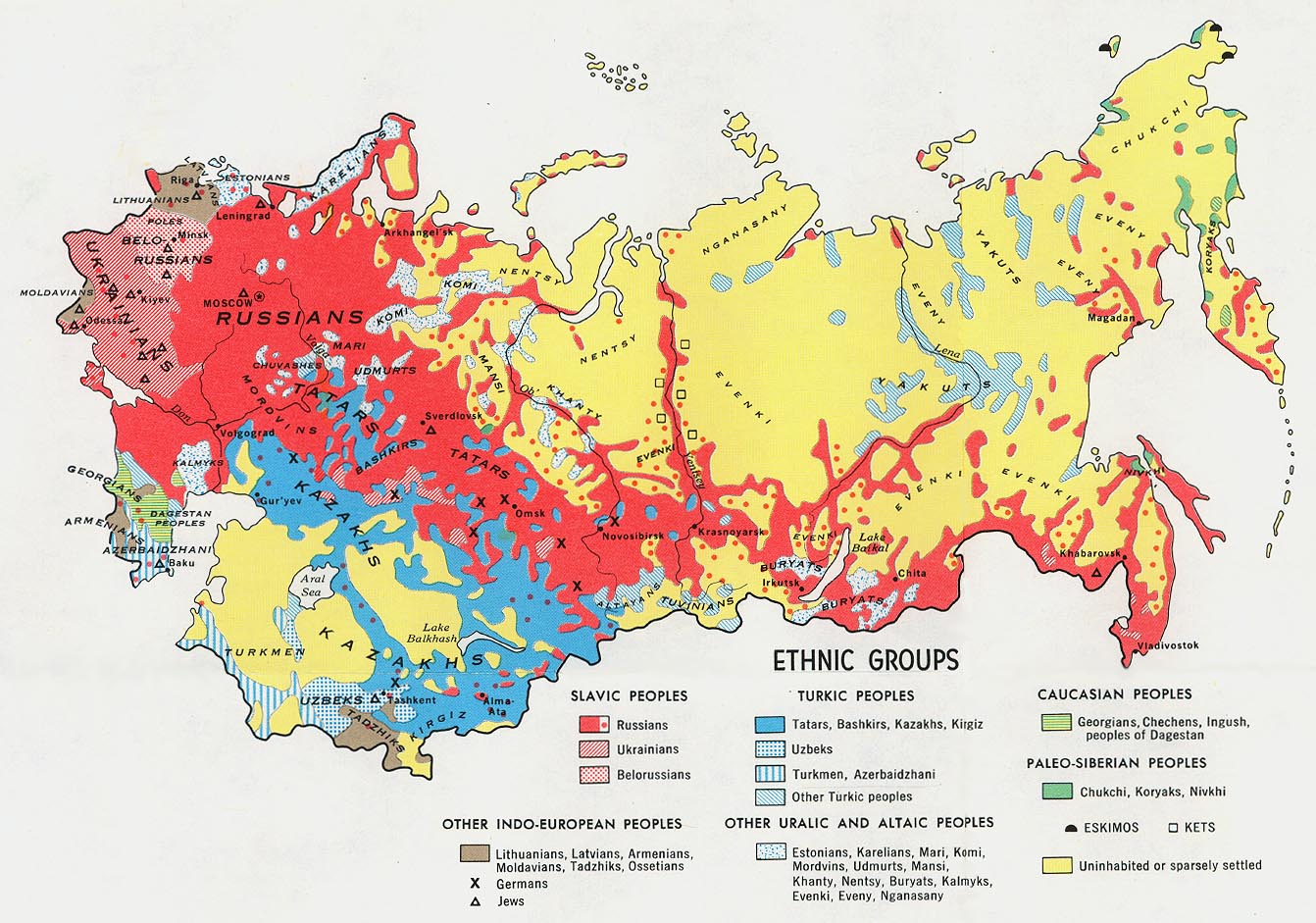
Simple ethnic map of the USSR in 1974, leeched from the University of Texas (click for full size)What purpose does “Russia” serve? Why shouldn’t the Chechens follow the Khazaks, Estonians and Ukrainians to independence? Why shouldn’t the Chuckchis, Yakuts, Buryats, Adyghes, Kalmyks, Chuvash, Karachays, Balkars, Ingush, Khakas, Komi, Udmurts, Nenets, Khants, Tatars, Mari, Mansi or any of the other federalised subgroups?

Just as I’ve long been asking what the EU’s for now that the original idea seems obsolete, Russia has been asking itself the same question. Without the binding ideology of communism for the elites (and fear for those beneath), what has been holding what remains of the Soviet Union together? As the Baltic states of Latvia, Lithuania and Estonia begin to thrive as part of the EU, as former Soviet territories like Georgia and Ukraine look to NATO membership and cozy up to the West – not to mention the old Russian Imperial territory of Finland (sitting pretty with the 12th highest GDP per capita in the world), what’s to prevent other parts of the Russian empire deciding that they’ve had enough?

Well, where the EU’s going for aspiration, after the brutally over-the-top actions of the Russian military in Georgia over the last week (and even more so in the Chechen wars – the second of which has technically been running for nearly a decade now), it’s hard not to see a return to federalism by fear. It’s a fine Russian tradition. Indeed, fear and repression are pretty much the only reason the old Russian Empire managed to hold itself together for so many years. Democracy in Russia has not been enough – opposition parties are still so under-supported as to be laughable. Authoritarian-seeming Putin, unafraid to act and act fast – remains Russia’s most popular leader since, erm… Stalin.

And so, it seems, we may be entering a new phase of Russian Imperialism:

“”It is clear that we need the kind of idea for which one will not be sorry to give one’s life. And the building of civil society, of the rule of law, of a prosperous society we find uninteresting. Indeed, we would rather squander everything and end our lives with suicide, than scrupulously count the credit and the debit, invest, corporatize, organize on cooperative lines, and so on. We find that tedious. We would rather try to absorb the enormous spaces of Siberia and the Far East, so that the islands of the Pacific Ocean become indigenously ours, we will fight for centuries with Europe for the Baltic States, and with Turkey for the Dardanelles – that is our way.”

(Original here, for those who can read Estonian…)

Related posts:

12 Comments For This Post

    1
  1. Colin Reid Says:

    The West would be a military threat if it was braver and better organised, and time is on its side. Russia can toss a minnow like Georgia around, but that’s like the UK demonstrating its strength by beating up Ireland. The reality is that the Russian military is still a pale shadow of the old Soviet military (which itself wasn’t all it was cracked up to be, as seen in Afghanistan), never mind comparing current Russian military power to the whole Warsaw Pact. The demographic future of Russia doesn’t look good either (it looks even worse for a few other European countries, to be fair, but still reasonable for US, France and UK).

    As a result, an obvious goal of Eurasianists is to keep the West disorganised and cowardly. Russia has to pretend it’s much stronger than it really is. So far, these tactics are working. But the contested area between the Western and Eurasian spheres is shrinking (apart from Serbia, all of it is now inside the former SU), and I doubt the Eurasians will be able to claim too much more of it.

  2. 2
  3. SD Says:

    You draw an interesting comparison between the EU and Russia, both ‘federations’ of very diverse peoples, and both looking for a raison d’etre.

    To me, the fact that countries like Ukraine and Georgia want to be part of the EU, and not Russia, is telling. I mean, if they just want to belong to a rich and powerful federation, they should be choosing Russia, right?

    Clearly this shows that the EU, with its gross imperfections and its lamentable powerlessness has a very deep appeal. I can only guess that the appeal lies with freedom, prosperity, peacefulness, aversion to power, regard for environment, post modernism, secularism, and the large degree of autonomy enjoyed by its members. (did I miss anything?)

    Time and again we see that eurosceptics hate the pretty nice society (at least, relative to most other places on the globe) that they live in, and disregard the attraction the EU has. Time and again they tell us that the attraction is because of wealth, but they should understand that Russia offers a lot more of that at the moment.

    Don’t get me wrong, I still very much want the EU reformed, now more than ever. And yes, the reform should be to make it more democratic (as Lisbon tried, but in a very ugly manner), as well as more efficient. But even the current EU is by far the most attractive large federation to live in.

  4. 3
  5. ESLaPorte Says:

    What was Russia thinking?

    Nope – Russia did not start this conflict, Saakashvili started this through his blunderous military action against South Ossetia. The reality is that Saakashvili was quite stupid for inviting conflict with Russia. When Georgian forces launched their military offensive against South Ossetia, Russian peacekeepers were killed. The response to Saakashvili’s military offensive against South Ossetia was not only predictable, but required.

    What was Russia thinking? NOPE – what was Saakashvili thinking when he decided to invade South Ossetia and kill Russian peacekeepers?!

    QUOTE: The Kremlin made abundantly clear that it would view Kosovo’s independence without Serbian consent and a U.N. Security Council mandate as a precedent for the two Georgian de facto independent enclaves. Furthermore, while President Saakashvili was making obvious his ambition to reconquer Abkhazia and South Ossetia, Moscow was both publicly and privately warning that Georgia’s use of force to reestablish control of the two regions would meet a tough Russian reaction, including, if needed, air strikes against Georgia proper.
    So it would be interesting to know what President Saakashvili was thinking when, on Thursday night, after days of relatively low-level shelling around the South Ossetian capital of Tskhinvali (which both South Ossetians and Georgians blamed on each other), and literally hours after he announced on state-controlled TV the cessation of hostilities, he ordered a full-scale assault on Tskhinvali. And mind you, the assault could only succeed if the Georgian units went right through the battalion of Russian troops serving as international peacekeepers according to agreements signed by Tbilisi itself in the 1990s.
    The Washington Note – Guest Post by DIMITRI SIMES: “What Exactly Did Saakashvili Think Would Happen?” (http://www.thewashingtonnote.com/archives/2008/08/guest_post_by_d_1/

    From the Times-Online, by Michael Evans, Defence Editor (http://www.timesonline.co.uk/tol/news/world/europe/article4500160.ece )
    QUOTE: “Georgia’s attempt to seize control of the secessionist South Ossetia region has been a gamble too far, reckless in its timing and founded on a fundamental misjudgment.
    The military adventure had all the hallmarks of rushed planning and a fingers-crossed strategy, launched in the hope and expectation that the Russians would not react, but that if they did, the Americans and Georgia’s other Nato friends would come to his aid in one form or another” (“Georgia: Reckless Saakashvili took on Russian Goliath Putin”).

  6. 4
  7. nosemonkey Says:

    Colin – yup, that’s got legs. A lot of Russia’s actions over the last decade or so can be put down to a growing inferiority complex. Putting it in the most trite possible way, they lost the Cold War and are now worried about losing what’s left.

    SD – an additional point of interest being the difference in attitude between the various parts of the former Soviet bloc. Again being trite, those to the West, with the sole exception of Belarus (and Transdniester, if that counts) seem to be looking to Europe, democracy, and the future; Russia and the Central Asian republics the focus seems instead to be on authoritarianism, conservatism (in the broad sense of trying to preserve things) and the past. Those regions on the fringes of Europe and Asia – notably Ukraine and the Caucasus – are pretty much evenly split between the two. This may well be worth exploring to find out just what “European identity” is all about – because some ex-Soviet states evidently feel it, while some seem to have no interest at all.

    ESLaPorte – Georgia was out of order, certainly (I’ve said as much several times), but that doesn’t make Russia’s actions justified. And in any case, the precise details of how this latest conflict escalated currently remain unclear. If Georgia suspected that Russian agents were behind the South Ossetian separatist movement, the various attacks along the border region and so on, they may well have been justified to use their military to protect their own borders. Whether South Ossetia should remain within those borders is another matter.

    You probably do, however, have a point about the Iraq issue. One thing Russia has got very good at over the last couple of decades is looking for precedents to justify its actions in terms of accepted international law. Any examples of Western hypocrisy – of which there are many – will have been carefully noted by the Kremlin to be brought in to future situations where they decide to act unilaterally. It’s the whole Team America: World Police thing all over again.

  8. 5
  9. ESLaPorte Says:

    If this was about putting down separatists, why then, go on and kill Russian peacekeepers?

    We also have reports of children and the elderly being run over by Georgian tanks and the like, but the blame should stop!

    In November 2006, the South Ossetians voted for independence from Georgia, something which few other nations recognized. If it can be given to Kosovo, why not South Ossetia?

    The reality is that both sides are blaming each other, but Saakashvili made a dumb mistake thinking he could settle the separatist problem with military force. Saakashvili should have chosen another solution other than attack South Ossetia and kill Russian peacekeepers.

    This situation is now like Kosovo, where we have a region of South Ossetia that wants independence and other forces that say no.

    An option that should be out is to shut Russia off and start another Cold War, and that might be just what some on the Western side of the Atlantic really want. Bush wants a legacy for himself and restarting the Cold War might be what he wants…

    The only solution is to work this out with Russia, Georgia and South Ossetia – and not start punitive measures, which are unwarranted and VERY counter productive!

  10. 6
  11. nosemonkey Says:

    It’s late, so I’ll do this point by point to keep my train of thought:

    1) The Russian “peacekeepers” were not necessarily just there to keep the peace. They were also not peacekeepers sanctioned by international law (as far as I’m aware), and were within territory that is, by international law, Georgian. Their status was, in other words, highly suspect – and that’s before you even start on the rumours (true or not I don’t know) that they were agitators, and that Russia was financing and supplying the South Ossetian separatists with weapons with which to attack Georgia.

    2) The South Ossetian independence referendum was not internationally recognised because, in part, it was suspect (partially due to Moscow’s interference in the region). And in any case, even with overwhelming support for independence or joining the Russian Federation (which I, for one, think there almost certainly is), a figure of 99% in favour sounds a bit dodgy.

    3) Yes, Saakashvili was stupid to use force – but so were the Russians (acting quickly was, under the circumstances of the Georgian breach of the ceasefire, entirely understandable – but if they’re just peacekeepers, why did they move outside the boundaries of South Ossetia and kill Georgian civilians in the process?).

    4) Yes, it’s like Kosovo – but not entirely. Kosovo is useful from the Russian perspective as a precedent, but at the same time the Kosovan situation is highly complex and equally unresolved. (Though I’d personally guess that South Ossetia is more homogeneously Ossetian than Kosovo is Kosovar, giving South Ossetia a greater claim to self-determination.) If you’re going to go for simple comparisons, you could equally compare the situation to that of the Basque country, blame the current troubles on a minority of violent separatists, and paint Georgia as the victim retaliating to extremist minority violence – that would, considering the complete lack of clarity regarding the situation, be just as valid (and, considering the uncertainty over the rights and wrongs of the Basque separatist case, be just as flawed).

    5) I doubt that anyone in the West is stupid enough to want a new Cold War with Russia when Russia controls 75% of the world’s natural gas – even discounting the sheer madness that a return to a Cold War situation would bring. If anyone does think that, no one in their right mind would listen to them – not even the maddest of the neocon caricatures. (At least, I really, really hope not…) It’s certainly not a mainstream desire among high-up political circles. (Again, I really, really hope not – because if it is, we’re ruled by madmen.)

    6) Yes, the only solution is to work it out with Russia, Georgia and South Ossetia – but Russia opted, instead, to invade with overwhelming force. Did they attempt to mediate? No. Did they attempt to use their position as one of the five permanent members of the UN security council to get an internationally-sanctioned solution? No. (And I’m not talking just after the Georgian military action when a speedy response was arguably required – I’m talking throughout the last decade and a half that this South Ossetian/Georgian standoff’s been going on.)

    In short, yes – I do to an extent buy the argument that Russia was acting in the purported interests of the Ossetians. But they did far more than was necessary to protect those supposed Ossetian interests – and thanks to the last decade and a half of Russian actions in the region (both military and otherwise), it’s not entirely clear what Ossetian interests actually are. But, at the same time, the actions of the West have also not been up to scratch – giving Georgia the impression that she had pretty much unconditional Western support almost certainly escalated the situation to the point that fresh conflict broke out.

    It’s really not black and white. Russia wasn’t necessarily a monster. Neither was Georgia. The only thing that is certain is that the South Ossetians remain screwed – and that this is a situation the international community really, really needs to sort out.

  12. 7
  13. Colin Reid Says:

    My guess on the final tally for carving out spheres of influence:

    Russia gets Belarus (I suspect it would have been annexed by now, if not for Lukashenko), Armenia (if dispute with Azerbaijan is unresolved), Abkhazia and South Ossetia, maybe Transnistria.

    EU/NATO/’the West’ gets the rest of Georgia, Moldova (maybe excluding Transnistria, which may end up getting Russified simply because all the non-Russophiles emigrate or die of old age), Serbia, Ukraine (eventually), Armenia (if the Nagorno-Karabakh thing ever gets resolved), Azerbaijan (eventually), and everywhere else in Europe that hasn’t already been mentioned (the rest of Europe is pretty firmly in the Western sphere anyway, whatever their formal membership statuses).

    This is all of course assuming Russia doesn’t have a sudden change of heart that causes it to really warm to the West. It’s also assuming the EU’s divisions over Turkey eventually resolve into something positive, rather than leading to Turkey drifting away from the Western club and adopting a more neutral foreign policy. With Turkey neutral, Russia’s position in the Caucasus would be a lot stronger and the West’s a lot weaker. Russia can still win back Ukraine as well, but this would require a major change of policy on Russia’s part (Ukraine is too strong to be ruled by fear of its neighbours), and time is running out. The best Russia can realistically hope for here is that Ukraine remains adrift, a buffer between East and West.

    ESLaPorte: It would be great if the EU and Russia could be best friends, or even have Russia as an EU member, but it has to be on terms compatible with the EU’s principles. Unfortunately, these are not really compatible with Putin’s principles. Maybe Russia will eventually become a liberal democracy, but it isn’t one now and won’t be until the power of both the oligarchs and the ex-KGB set has faded.

    I also think that we will ultimately have to accept the de jure separation of South Ossetia and Abkhazia from Georgia. However, any long-term solution has to include strong protections for the ethnic Georgian minorities of these places, including those who have been expelled and want to return. The difference with Kosovo is that the EU are there in force to maintain such protections – Kosovars are not yet trusted enough to do this on their own, just as Bosnia is still not trusted to hold itself together. It seems doubtful that Russian peacekeepers could offer equivalent guarantees, because the Russian government does not even protect its own people from abuses of power.

  14. 8
  15. Colin Reid Says:

    Nosemonkey: South Ossetia is (or was) roughly two-thirds Ossetian, 30% Georgian, 4% other (the others are mostly pro-Russian). Before the war, Abkhazia was 45% Georgian and less than 20% Abkhaz, with Georgians distributed all over the Autonomous Republic – the current demographics are the result of ethnic cleansing.

    Kosovo is approximately 90% Albanian nowadays. We don’t know what it was in the early 90s, but certainly well over 80%. So the numbers are quite different.

  16. 9
  17. ESLaPorte Says:

    “It would be great if the EU and Russia could be best friends, or even have Russia as an EU member, but it has to be on terms compatible with the EU’s principles.”

    Yes, and that was said about Serbia too…
    Russia and Europe NEED to work together on these issues (along with the other parties). A Bush-like neoconservative “not talking to your adversaries” is not only counter productive, but counter to what the whole European project is really about. Moscow needs to talk to Brussels!

    And – ANY policy or action that seperates and divides Russia from Europe must be avoided!

    Are we also forgetting that Georgia started this latest conflict?
    Something needs to be done to make Georgia into a European democracy, as European democracies do not solve disputes by attacking regions in its own borders. What Saakashvili tried was similar to what Milosevic did, that is, solve a “separatist problem” through the use of military force.

  18. 10
  19. Nazira Says:

    I am from Kazakhstan, and I would like to note that whole crisis is not just crisis in Caucasus but is the crisis of the whole post-Soviet space and for the Russia-led Commonwealth of Independent States.

    As Georgia declared that it leaves the union and calling upon other members to do so, this might have a negative effect for the whole post-Soviet states. I would like to note Russia DID NOT enjoy any official support from any of the members in CIS, except for a very initial general verbal concern over the situation from Kazakhstan and Belarus. So even Russia’s close allies like Belarus and Armenia, did not approve Russia’s attack.

    Currently I think every single CIS member is trying on this whole crisis for itself and that tries to imagine who might be the next… Ukraine…? Azerbaijan…? Kazakhstan…? Unfortunately, every single CIS member has either a common border / frozen conflict / ethnic minority whose rights might need to be protected in future / oil and gas resources, that might serve as a pretext for various geopolitical strategies for dismemberment… What is clear to me is that one CIS member attacked/forced to appease another CIS member and this is the first incident in the history of the CIS and it showed that right is the one who has the power or more powerful patron otherwise you are dead and will be the object and not the subject of international polics.

    As it is clear that the CIS will be reformatted and reformed now or who knows, maybe even dissoIved, it a high time now for every CIS member State to make its choice whom to side with and from whom to distant itself…?
    The current domestic political discourse in Russia is: we are strong now… from now on we will act based on our interests…
    And some political analysts even call upon taking back Crimea and sevastopol, lands of northern Kazakhstan, where russan-speaking minority lives, maybe they also have received already Russian passports…? They are preparing to put pressure on Kyrgyzstan, who hosts both US-led ISAF/USAF base and Russian base, to kick out the ISAF/USAF base that is non-combatant fuel/operations support to Afghanistan mission. Russia keeps threatening and bullying Central Asian Republics with China. Their typical rhetoric is: if you don’t stay with us, you will be assimilated by China. But with growing fascizm and racism growing in Russia, where people of Asian and Caucasus ethnic groups get killed and stabbed and sliced from the back by groups of Russian skinheads, just for a different skin color and eye cut, it will not long ago that Russia will fall apart, as there are other 179 ethnic groups that compose so called RF. I am sure that as soon as Russians declare that Russia is for Russians only, that will be the end of it! Because Tatarstan, Bashkortostan, Chechnia and all others, who are not Russians will want independence.
    So western community, don’t be fooled by the hand of Kremlin. They tell the west one thing; what they do in their “near abroad” is completely the opposite.

  20. 11
  21. monkeynose Says:

    I think you should take your nose out of your monkeys ass! You seem like the typical “read what the US media tells me and I will base judgement on these ‘facts’” Try doing some research before commenting I would suggest.

  22. 12
  23. nosemonkey Says:

    Your last sentence? Right back at you.

Hire Nosemonkey!


MORE EUROBLOGS:
EU Blog Directory | Bloggingportal.eu

Must-read EU blogs | More EU blogs
Politician blogs | Press/Think tank blogs
Subject specialists | The East | The West
New blogroll additions

Like this blog? Why not show a little PayPal love and help keep it going?

Donate in Euros:

Donate in GBP:

Advertisement

Read reviews of Organic Liaison and other new weight loss products!